
Growth is happening, Community voices are helping shape what comes next.
As the leaves change and Frederick welcomes a new season, East Frederick is experiencing one of the most transformative periods in its history. From the groundbreaking of Frederick Brickworks to the latest milestone for the proposed cricket stadium, major investments are beginning to reshape our community. New neighborhoods, businesses, parks, and transportation improvements bring exciting opportunities to create a more connected, vibrant, and welcoming East Frederick. But with growth comes an important responsibility. The decisions made today will influence our neighborhoods, schools, streets, and public spaces for the next 20 to 30 years. At East Frederick Rising, we believe thoughtful development must balance economic investment with the needs of residents and businesses. This fall, we’re celebrating meaningful progress, highlighting the impact of community advocacy, and encouraging everyone to take an active role in shaping Frederick’s future.
East Frederick is entering an extraordinary period of change. Projects like Frederick Brickworks, Canterbury Station, the proposed cricket stadium, and improvements along East Street are creating new opportunities for housing, business investment, recreation, and connectivity.
We welcome this investment and recognize the important role that developers, City leaders, and community partners play in Frederick’s continued success. But growth is about much more than constructing buildings. It is about creating neighborhoods where families can thrive, businesses can succeed, and future generations will be proud to call home.
The decisions being made today will shape Frederick for decades. That is why East Frederick Rising believes every major development should leave behind a lasting public benefit—whether through protected parkland, safer streets, connected trails, historic preservation, improved infrastructure, or accessible community spaces.
Recent discussions surrounding Canterbury Station demonstrate how meaningful public participation can influence development plans. Residents and community organizations have an important role in identifying needs, asking questions, and helping decision-makers understand neighborhood priorities.
Our responsibility is not to oppose growth, but to help ensure we get it right. I encourage every resident to attend a public meeting, review proposed plans, email elected officials, and share your perspective. You do not need to be an expert in planning or development to make a difference. Your experience as a resident, parent, business owner, or neighbor is valuable.
The future of East Frederick should not simply happen around us. It should be shaped with us.
Thank you for your continued support and for helping build a stronger, more connected Frederick.
Heather Goddard
Board President, East Frederick Rising
Renn Quarter: Planning Commissioners balk at approving a drive thru in Lot 2 (and Another Retail Lot is coming)
For Background: In Renn Quarter, developers attempted to change the Land Management Code through a text amendment that would have allowed them to apply to proceed with residential construction before beginning the retail portion of this Mixed-Use development. Residents pushed back, packing half a dozen meeting rooms and writing in their concerns for the retail amenities they had been promised when buying their homes in Renn Quarter. For 18 months, the text amendment application moved slowly through the planning commission, and then the City Council, before being unanimously denied by both bodies. This forced the developer to submit plans to construct at least 25% of the required square footage of retail before they can begin to build the remaining residential component (a 250-unit multifamily building.) This retail lot, called Lot 2, has been progressing through site plan review, with the most recent meeting at the planning commission workshop on October 19. There is a problem with the 4-building site plan, however; planning Commissioners continue to push back on the drive-thru building. The planning commissioners could deny the request for a modification of the setback rules (the plan shows the drive thru setback at 58 feet, where the maximum requirement is 35 feet) that apply to Mixed-Use developments. If the planning commissioners deny this modification request, it would make construction of the drive-thru impossible. Due to the negative feedback from the planning commissioners, the developers requested a continuance of the planning commission meeting to go back to workshop to continue to appeal for the commissioners’ support. They created a visual to illustrate the pedestrian routes and open space, shown above, and noted that they added additional landscaping to screen the drive thru from Monocacy Boulevard. Also, they added almost an acre of open space composed of pocket parks and a common ‘lawn’ area (no open space is required per the LMC); also, where the minimum tree requirement is 73, this plan has 121 trees provided, and they also incorporate 14 feet- wide sidewalks, where the LMC minimum width for sidewalks is only 5 feet. 
Lot 2 is subdivided into two parts. One part has three retail buildings and the other part has the fourth drive thru building. Unless all parts of Lot 2 are approved, the developer won’t have enough retail square footage to proceed with the multifamily building construction as they desire. Plus, any rejection of these plans will result in a delay in the construction of this lot, which would disappoint residents who have been waiting so long for a walkable retail component of their neighborhood. On the other hand, a drive thru invites increased traffic, creating potential conflicts between pedestrians and cars in what should be a walkable and safe neighborhood retail district. Later that night, at the City-Wide Planning Department Outreach meeting, developers presented a preliminary plat for Lot 1, another retail lot in Renn Quarter, splitting the lot into two parcels. This is very early in the process; this is a preliminary plat subdivision with no site plan yet, but the community can take a first look at the location of the next retail lot in Renn Quarter. NAC Planning Presentation East Frederick Rising will be tracking this development as it progresses through to site plan review.

On October 16, 2026, City officials, representatives of the Washington Freedom, and development partners gathered for a ceremonial groundbreaking for the proposed Special Events Center near East Patrick Street and Interstate 70. The privately funded venue is envisioned as the future home of the Washington Freedom Major League Cricket franchise, while also hosting community activities and other events.

In August, the Frederick City Council approved rezoning of the Gateway Property, allowing the proposal to advance through the development process. Although initial field preparation and site grading may begin, the City has emphasized that full stadium construction cannot begin until the site plan receives approval and the required permits are issued. The developer is targeting a 2027 opening, subject to remaining approvals.
The plan for the property envisions year-round community access and recreational opportunities beyond professional cricket matches. Also included is a restaurant near the stadium entrance.
East Frederick Rising recognizes the economic and recreational opportunities the project would bring to Frederick while continuing to advocate for a lasting public asset that balances investment with neighborhood quality of life. We will continue to track updates and await the site plan submission.
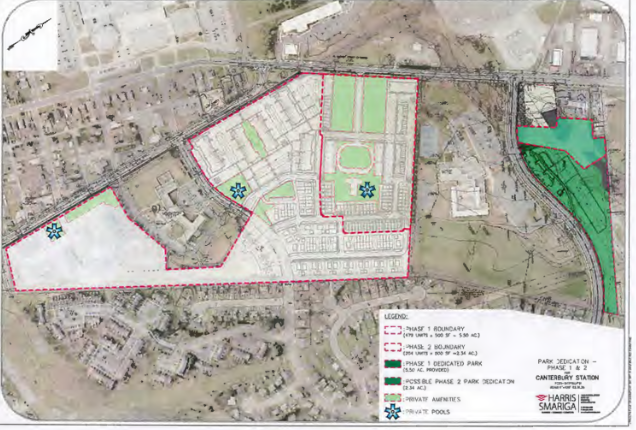
This map shows the existing dog park shaded in dark green. The new parkland dedication is shown in light green with a red border. Canterbury Station, which is located on North East Street and North Market Street and includes the former Banner School, is a development on 53 acres and contains almost 500 residential units. It offers an important example of how public participation can influence development outcomes.
During the April 2026 Parks and Recreation Commission meeting, East Frederick Rising spoke against a request to waive approximately 2.4 acres of additional parkland associated with 204 proposed residential units. Other community members wrote to the Commission expressing their concerns that waiving parkland requirements would leave hundreds of new community members without adequate open space, and that waiving the fee-in-lieu would leave the city without any money to improve existing parks nearby. Following the discussion, the developer withdrew the waiver request and revised the plan to include the additional parkland.
This is a meaningful step toward ensuring that new residential development contributes to the recreational needs of both current and future residents. The revised plan remains subject to applicable review and approval requirements.
The City also initiated improvements to the Canterbury Station Dog Park in June, including redesigned entrances, fencing, railings, and pathways to improve accessibility and safety.
Why it matters: Canterbury Station demonstrates the value of community involvement. When residents participate early, they can help shape development plans and advocate for amenities that will serve neighborhoods for generations.
The City of Frederick continues to slowly advance planning efforts to improve the East Street Corridor, an important connection between Downtown Frederick, existing neighborhoods, and new development. This infrastructure project has been listed as a priority for funding by the Planning Commission, a recommending body that issues a yearly letter of support for critical infrastructure Capital Improvement Projects, since 2018, yet the East Street Redesign project remains largely unfunded year after year. The East Street Redesign initiative focuses

on pedestrian safety, bicycle access, roadway improvements, and streetscape design. These improvements will become increasingly important as new residential and commercial developments bring additional activity to the corridor. EFR continues advocating for safer intersections, connected sidewalks, improved bicycle infrastructure, and streets designed for residents of all ages and abilities.
Planning staff notes in their 5-year Work
Plan Report that the City has no imminent plans to implement the East Street Redesign, and not until 2030 do they even plan to “assess staff capacity to achieve 100% design.” WorkPlan2027-2030Rev8_FINAL
On September 29th, The City of Frederick invited residents, commuters, business owners, students, and neighbors to provide input on the future design of North Market Street, from 7th Street to Routzahn Way. The City launched a study on how to make North Market Street safer and easier to navigate for everyone. To achieve this, the City is evaluating safer bicycling infrastructure along North Market Street and Routzahn Way and evaluating the feasibility of a modern roundabout at the intersections with North East Street and Routzahn Way.

The workshop was held on Tuesday, September 29, at the Municipal Annex. At the meeting, residents learned how protected bike lanes and modern roundabouts work to improve safety. Planning and transportation departments used large maps to capture residents’ thoughts and concerns, as well as their firsthand knowledge of the North Market Street corridor. Councilmembers Sarah Hempel Irani and District 4 councilmember Joe Adtkins were on hand to
talk with the community about how proposed improvements can best meet the needs of the North Market corridor. Activities were available fo r students to give their feedback, too.
The project is supported by a $288,000 grant from the US Department of Transportation’s Carbon Reduction program, matched with $72,000 in City funds. The project is funded through 100% design, and it is expected to take two years to be shovel-ready.
East Street Rails with Trails | The City of Frederick, MD – Official Website
Phase 2 is set to break ground in 2027, Phase 3 in late 2028
The East Street Rails with Trails initiative remains an important part of Frederick’s long-term multi-modal transportation vision. The 3.4-mile shared-use path is a plan in four phases, and East Frederick Rising reached out to project manager Robert Barrick for updates.
As a reminder, here is a description of the first three phases of the City Project:
Phase 1
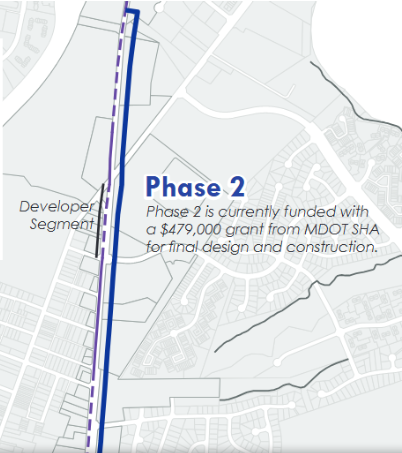
Phase 2

Most Recent Update October 2026:
The 100% design began in May 2026, and was finished over the summer. It has been provided to MDOT and the City. Mr. Barrick, the project manager, states that “If all goes well we should still be on track to bid out for construction early 2027.”
Phase 3

Phase 3 Timeline
East Frederick Rising is particularly concerned about the Phase 3 timeline. The City of Frederick requested a 3-year extension for the federal grant funding for this phase, but was only approved for a 1-year extension. We reached out to Mr. Barrick to make sure that there would still be time to consult with the community, including NACs 7 and 4, on the bridge design, which is a condition of the grant. Mr. Barrick reports that “We have pushed back some elements of this project and moved forward others for reasons related to the Federal and State funding of the project. [The] 30% design is ongoing and still anticipated for November, we will work on the plan for public outreach around that time. In the meantime we are working with MDOT to expedite the environmental review for the project, as that is critical… to obligate construction funding earlier, and potentially begin construction earlier. We will be working out the details of the 60-100% design and construction schedule and the outreach program in November with the consultant and MDOT.” Mr. Barrick noted that he “will have a better idea of the schedule for the NAC and public official coordination in November,” but assured us that they “do not plan to advance the project past 30% design without having these consultations.”
Placemaking and Wayfinding along the Rails with Trails
We’ve expressed our support for compliance with the condition of the Phase 3 grant – the importance of incorporating a public process that would involve and engage residents and property/business owners when designing the signs, bridge, and wayfinding elements that will define the character of the Rail Trail in a way that reflects the history and character of the Frederick community. The master design for the Rails with Trails project was begun in 2013, and while of course the priority is that construction funding is able to be obligated so the City doesn’t lose millions of dollars of grant money, we feel that after more than a decade, it would be unfortunate to have to move to construction without a design process that welcomes, includes, and integrates the ideas of the community. Mr. Barrick responded that “a new City CIP has been created in Fiscal Year 27 to develop a wayfinding signage system for our parks which will include shared use paths – see the link to CIP scope – City of Frederick CIP – FY 2027 – FY 2032 | 410046 – Park Signage and Wayfinding – and when the scope of work is sent out for the RFP for the wayfinding sign consultant, we will include all four of the Rails with Trails phases in the scope of that CIP. The wayfinding sign consultant will work with the community and groups such as EFR to solicit input and ideas for the wayfinding signage program.”
We are grateful that the City will be able to accelerate the construction of the Rails with Trails, including the pedestrian bridge, as well as preserve the opportunity for community design and placemaking with this new CIP!
We will continue to keep you informed about the progress of the Rails with Trails project as it moves through these critical design stages towards construction. Please contact your Neighborhood Advisory Committees, NACs 4 and 7, for more information about when the City will be meeting with them to discuss the bridge and wayfinding sign design. Your input matters, and will help shape this project so that it reflects the rich history and character of the community!

As new developments reshape East Frederick, an important question remains: How can we ensure new buildings contribute to the character, walkability, and long-term success of our neighborhoods? Form-based zoning offers one approach. Rather than focusing primarily on how land is used, it places greater emphasis on how buildings interact with sidewalks, streets, parks, and public spaces.
For East Frederick, this could encourage active storefronts, pedestrian-friendly streets, connected neighborhoods, and development that complements surrounding communities.
On October 5, East Frederick Rising joined a representative from the Downtown Frederick Partnership to review a buildout analysis study of the subject area along the East Street Corridor. The analysis was completed by Stantec, the consultant that has been working with the City to write the East Frederick Vision Plan (link) and the regulatory framework of East Frederick Form-Based Code. The study concluded that the total built area calculated under the Conservative Scenario as 3.1 million square feet, and under the Aggressive Scenario as 9.1 million square feet. This study will allow the City to project that population growth in the subject area could range from 5,000 people conservatively, to 14,000 people in the aggressive scenario. In a separate meeting, members of the development community were also invited to share their thoughts.
As major development moves forward, EFR encourages continued collaboration among City officials, developers, residents, and businesses to foster discussions regarding the growth of the East Street Corridor. Especially since the City has pivoted its focus to renewing the Golden Mile Small Area Plan, we urge stakeholders to ask questions about the regulatory frameworks that will guide implementation of the visions of the small area plans. If no regulations are implemented, then the vision will not be able to guide development.
Community development is not simply about new construction. It is about creating places where families can grow, businesses can succeed, and neighbors can connect.
Residents can help shape this future by attending public meetings, submitting written comments, reviewing development proposals, and asking questions before decisions are finalized.
The most effective time to influence a development is often before its final approval—not after construction begins.
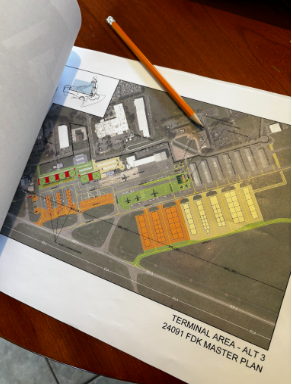
On October 14, work continued on the Frederick Municipal Airport (FDK) Master Plan. Airport Master plans are usually completed every 20 years and include near term and far-range planning efforts for phased infrastructure needs and development over the next two decades. As an East Frederick business owner and Board President of East Frederick Rising, Heather Goddard joined a stakeholder group for their third meeting since January. At the meeting, Delta Airport Consultants Inc. presented several potential development alternatives and listened to feedback as the group discussed their preferred elements of each concept to best plan for future infrastructure needs and plan for aviation demands. Stakeholder input will play an important role in refining these concepts and ultimately shaping the Preferred Development Alternative, which will be reflected on the Airport Layout Plan. Important considerations that were discussed included:
For Juan Pablo Hoyos, owner of Frederick Quartz & Remodeling, Frederick is more than a place to do business; it’s home. Juan Pablo immigrated to the United States from Colombia at just 15 years old, alongside his mother and two older siblings. With an entrepreneurial spirit shared by his family, he focused on learning English, understanding American business practices, and discovering opportunities in the community that welcomed them. What drew his family to Frederick was its small-town charm, a familiar feeling that reminded them of home in Colombia.
 Over the years, Juan Pablo has watched Frederick transform into a growing, culturally diverse community while building both his family and his business here. Through Frederick Quartz & Remodeling, he helps homeowners bring their renovation ideas to life, contributing to the homes and neighborhoods that make Frederick special. One of his favorite parts of doing business locally is meeting customers from around the world, reflecting the cultural richness Frederick has developed over the years.
Today, Frederick Quartz & Remodeling represents more than one family’s entrepreneurial journey. It reflects the determination, craftsmanship, and community connections that help local businesses thrive. Whether you’re planning a kitchen upgrade, considering new countertops, or exploring a home remodeling project, Juan Pablo and his team invite you to reach out for a free estimate and discover how they can help bring your vision to life. Visit: www.FrederickQR.com
Recent renovations at Staley Park have prompted questions from Frederick families about playground design, accessibility, and opportunities for community input. Although the park is outside East Frederick Rising’s boundaries, the response from residents underscores a broader lesson: meaningful public engagement matters when changes affect the places people use every day.

As reported by the Frederick News-Post in “Frederick parents frustrated after changes at Staley Park”, the renovations replaced the park’s decades-old playground, including its fenced-in tot lot and sandbox. Residents have raised concerns about losing a contained play area for young children and having limited opportunities to provide input before the changes were made.
Local parent Amy Sprague has helped bring these concerns to light by launching a petition to restore the Staley Park tot lot. The petition calls for a dedicated play space for toddlers and young children, with fencing, shade, seating, and age-appropriate equipment. It also asks the City to review its public engagement process and include residents and park users in future decisions about significant park renovations. Sprague has emphasized that the former tot lot served not only as a play area but also as a gathering place where children and parents could connect.
The daycare center operating from the downtown YMCA was also affected. According to a statement from YMCA CEO Chris Colville to the FNP, “The removal of the playground fence does adversely affect our ability to use the playground for our Head Start program because (the Maryland State Department of Education) requires fully fenced playgrounds for any licensed childcare centers… We are hopeful that the city will resolve the issue swiftly and support our needs to be in compliance with the state of Maryland.”
Additionally, the North End Civic Association, which built and maintained the park until the city took over in 2010, sent a letter to the City requesting a review of the process used to obtain neighborhood input, noting that they were never consulted. In the letter, the NECA recognized that “the City must balance many competing priorities and that no park design will satisfy every resident.” However, they say that “what NECA is hearing directly from residents: families believe something important was lost when the dedicated toddler area was removed, and they would like a meaningful opportunity to participate in determining how that need should now be addressed.”
To better understand the City’s approach, East Frederick Rising reached out to Bob Smith, director of the City of Frederick’s Parks and Recreation Department. Smith explained that playground renovations are generally guided by the City’s Master Parks Plan, GRASP Inventory Atlas, and the age and condition of existing equipment. The Staley Park project was approved at the June 4, 2026, City Council meeting.
According to Smith, the original equipment was installed around 1990 and no longer met current playground safety standards. The replacement equipment is designed for children ages 2–12, with features intended for different age groups. The sandbox will not be replaced due to sanitation concerns, and planned improvements include expanding the paved path to connect park amenities.
The discussion raises an important question for parks planning: how can cities balance safety standards and long-term maintenance with the needs and experiences of the families who use these spaces? The response to Staley Park demonstrates why residents should have meaningful opportunities to share their experiences and help shape public spaces before decisions are finalized.
How you can get involved: Residents who wish to share feedback about Staley Park can sign or share Amy Sprague’s petition, or reach out to their City Council representatives through the City’s Ask Your City Council page.

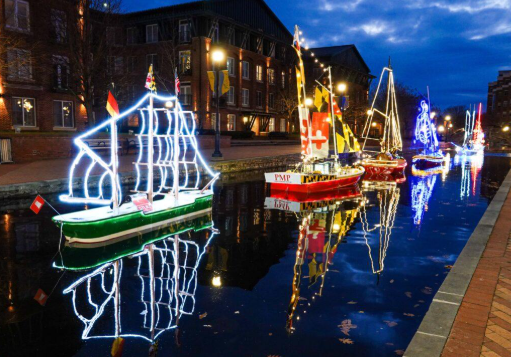
Sailing Through the Winter Solstice
Saturday, November 21, 2026 –Launch activities begin at 8 AM.
This seasonal tradition brings illuminated boats and holiday spirit to Carroll Creek. Downtown Frederick continues to offer community celebrations, arts programming, performances, and seasonal activities that support local businesses and bring residents together.

Your voice helps shape Frederick’s future. Attend City Council, Planning Commission, and Parks & Recreation meetings to learn about projects, share concerns, and participate in local decision-making.
Planning Commission hearings and workshops generally take place at City Hall, 101 N. Court Street. For updated agendas, times, and participation instructions, visit the City of Frederick Official Calendar.
East Frederick Rising is excited to introduce our Givebutter fundraising campaign, providing residents, businesses, and community partners with a new opportunity to support our mission.
Your contribution helps EFR continue providing educational resources, community newsletters, local business spotlights, neighborhood engagement, and advocacy for responsible development.
From protecting public parkland to promoting safer streets and helping residents understand local planning decisions, our work is centered on one belief:
Every development should leave Frederick better than it found it.
Whether your contribution is $10, $50, or $100, every donation helps us continue connecting residents, supporting local businesses, and advocating for the future of East Frederick. Click Here to Donate!
As East Frederick continues to grow, staying informed has never been more important.
Follow East Frederick Rising for development news, neighborhood announcements, community events, business spotlights, and opportunities to participate in the decisions shaping our community. Together, we’re building more than neighborhoods. We’re shaping the future of East Frederick. Visit eastfrederickrising.com to learn more.
We value your feedback and suggestions. Feel free to reach out to us at:
info@eastfrederickrising.com
Thank you for being an essential part of the East Frederick community.
“Meet you on the East Side!”
-East Frederick Rising